
For twenty years I have designed for a human on the other side of the screen. I think that assumption is ending. The visitor to a website, an app or a service will increasingly be someone’s AI agent, sent to find, compare, decide and buy. My prediction, and it is only mine, is that most of the work of user experience will come to be done by agents, and that the parts which stay human are the ones I think a designer is for: judgement about why a service exists, and about what a person should feel when they arrive.
The signals piled up in three weeks. Google’s John Mueller said the old “position one to ten” model is hard to map onto today’s results pages, because AI splits your question, reads the pages for you and hands back an answer. Meta’s Muse went to number one on the US App Store as a personal agent that goes off and does the task. OpenAI pitched GPT-6 heavily on using a computer the way a person does. Deloitte is hiring forward deployed engineers, a role Palantir invented to put an engineer inside the client’s team and make the product work in their real data and workflow. Don’t become the choke point, the place where an automated flow has to stop and wait for a human.
To see what that does to design, I borrow Jesse James Garrett’s five planes from The Elements of User Experience: strategy, scope, structure, skeleton, surface. Every plane in that model was designed by humans for humans.
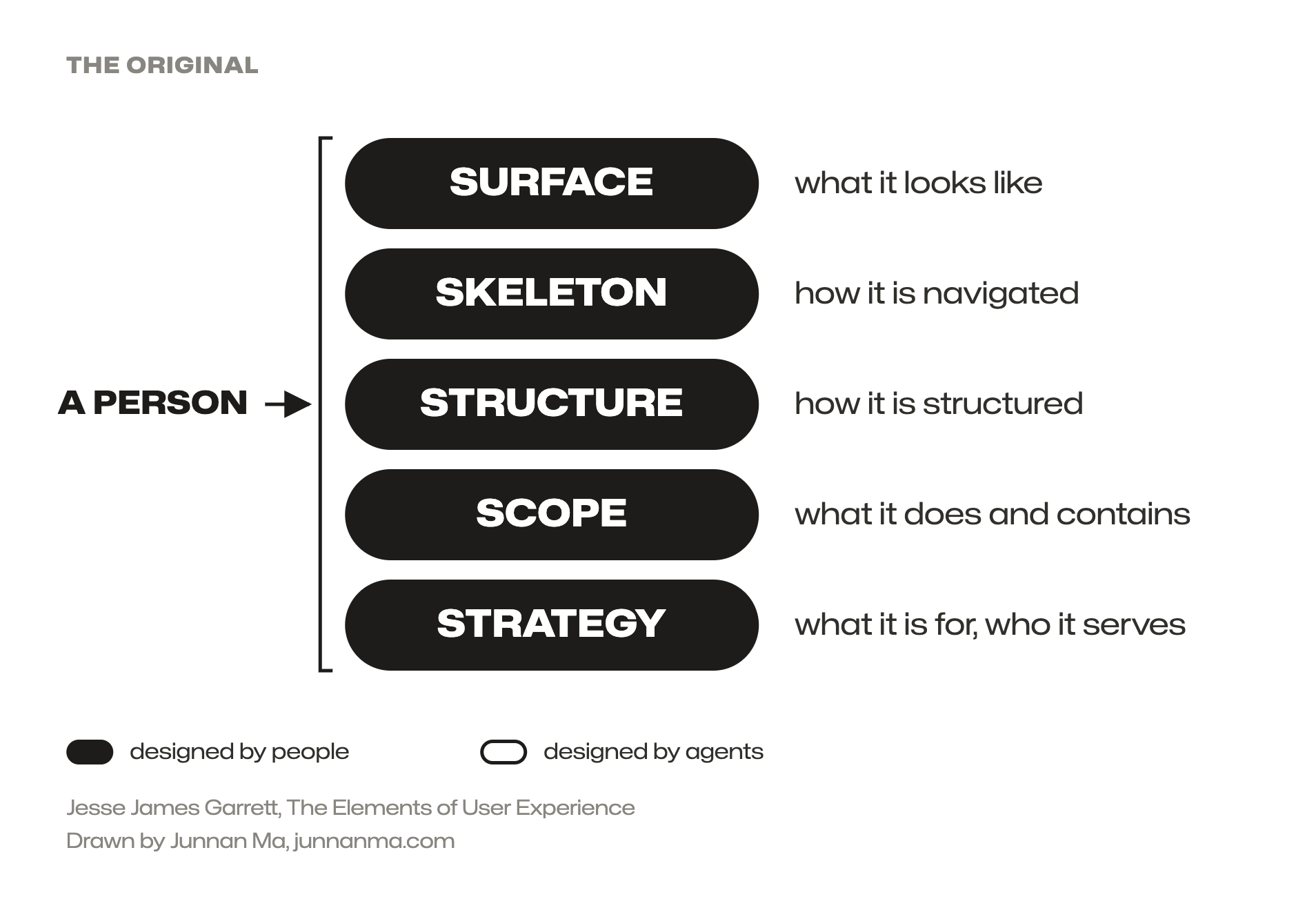
I think the middle three will increasingly be designed by agents: what a service does and contains, how it is structured, how it is navigated. That work is logical, and logic is what agents are good at. The two ends still need human judgement. At the bottom, strategy is still people deciding what a service is for and who it serves, including whether to let agents in at all. When Amazon blocked Meta’s Muse from shopping on its site in September, that was people making a strategy call. At the top, people don’t stop being emotional, visual, system-one animals. They will hand the functional and informational work to an agent, and they will still need a visual and emotional anchor to an entity, a touchpoint that resonates, gives a wow, or establishes credibility at first glance.
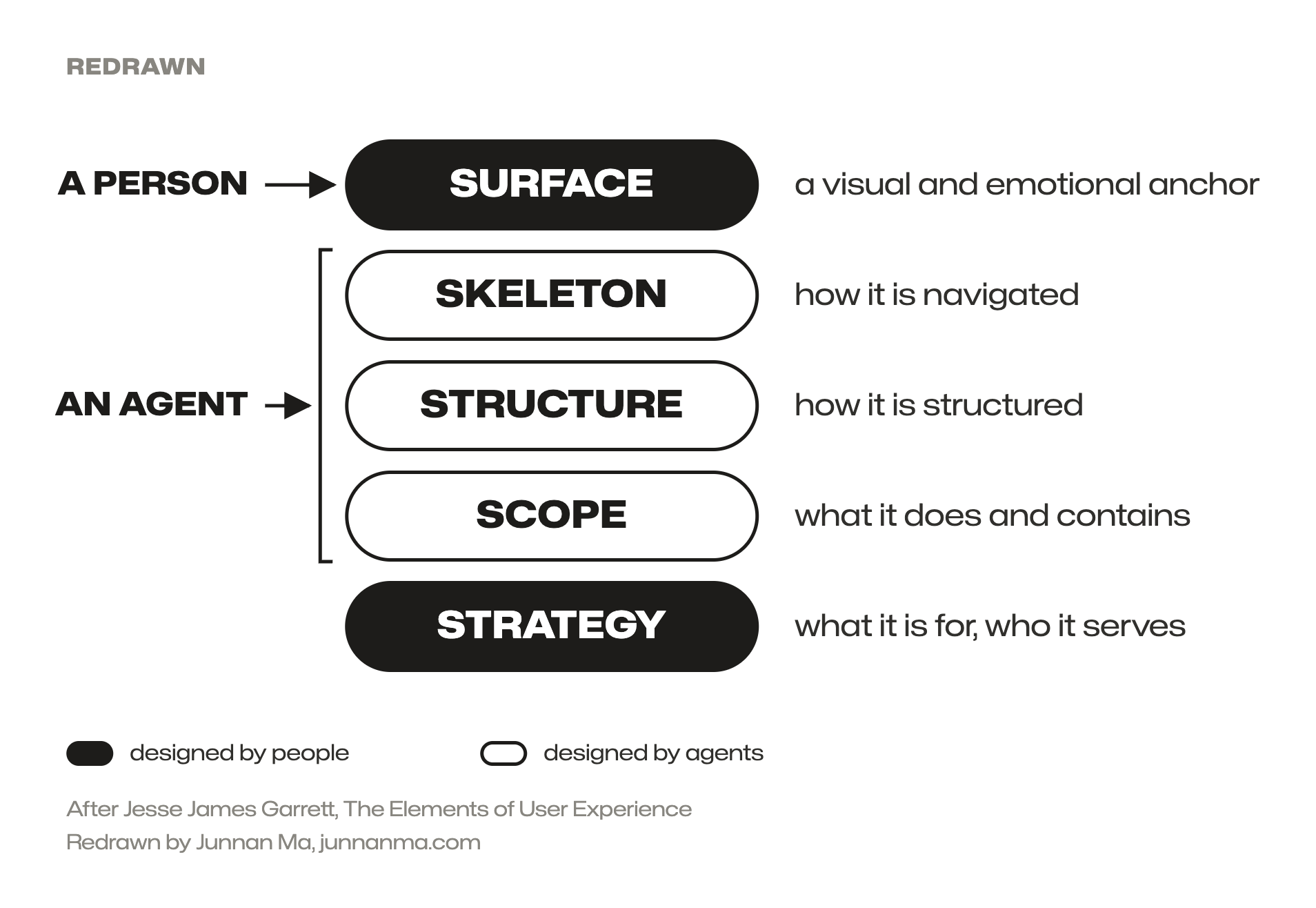
AI generates surfaces easily, and it will get better at it. What it lacks is the judgement about which surface is right for this brand and this person, and that judgement is where I think a designer’s value moves. The planes in the middle still need designers who understand them well enough to direct the agents doing that work.
My bet on timing is about five years before most people are used to handing a lot of their day to agents. About half of American adults now use an AI chatbot, up from a third in 2024, and about a quarter of people who use AI use an agent regularly.
The business side will be slower and more uneven, and that is the side that pays a studio. Australia shows the gap. Australians use generative AI at a higher rate than Americans, yet only 12% of Australian organisations say it is already transforming their business, against 25% globally. Customers are ready and companies aren’t, and that gap is where the opportunity is, for anyone equipped before the scramble starts.
Most of what I do with AI is what I already knew how to do, faster. I suspect I’m not alone. For most designers I know, these tools have multiplied their existing skills without stretching them. Take the AI away and the work still gets done, slowly. Our speed has grown a lot and our skill sets have barely moved. The low hum of anxiety many of us feel comes from that gap, between how far the tools could stretch us and how little they have, because it is so easy to point them at what we already know.
If the visitor is becoming an agent, the stretch that matters is understanding how agents work: how one reads a service, what context it needs, how you tell whether it did the job. The tempting objection is that AI changes every day, so anything you learn about it gets replaced. Churn hits tools and model names. It barely touches how an agent reads a service or what context it needs.
The surface craft still matters too. There, the stretch is vocabulary, enough to direct an AI the way you would direct a developer and to judge what comes back.
Designers won’t compete with engineers on any of this, and don’t need to. But someone has to orchestrate the whole, and the person who understands both the people at either end and the agent in the middle is the one companies will need.

